Do I have a frozen shoulder?
The term frozen shoulder describes the gradual process of inflammation and changes to the internal structures that occur within the shoulder joint. Sometimes this occurs for no reason, sometimes after a fall or other mild trauma such as lifting at arms length or at an awkward angle.
The healthy shoulder joint has a large available range of movement and this requires the internal capsule of the joint to be quite loose. In this process the inflammation tends to collect in the loose folds of the capsule, which seems to prompt changes in the capsule, especially at night when the joint is still. It is sometimes the case that the joint affected is the one that you like to lie on at night and this usually becomes difficult then too painful as the condition progresses. This often causes loss of sleep.
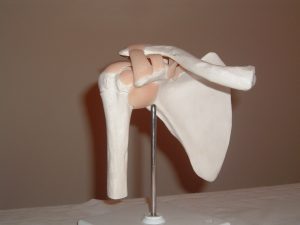
The commonest sign of a frozen shoulder is the loss of range of movement. This always affect the rotational ability so it becomes hard then impossible to reach up behind the back, and there is often difficulty taking off sweaters and tops that don’t undo at the front. Reaching over the head is usually difficult but sometimes manageable if done slowly. Sudden movements are almost always sharply painful. The pain is usually felt on the outer part of the upper arm sometimes in the forearm and hand. There is often an aching around the shoulder blade as the muscles work harder to move the stiff joint.
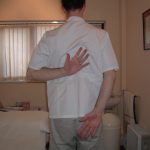
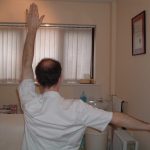 The right arm shows the typically limited range of movement in a frozen shoulder.
The left arm range is considered normal.
The condition is eased by physical therapy such as osteopathy. Treatment consists of mobilization and massage to reduce the pain and help with sleep.
A programme of exercises is commonly prescribed to help maintain and then regain the movement in the joint.